



From the Strap Bag to the Kelly
When a Hermès creation enters fashion history
The history of the Hermès Kelly bag predates the name by which the world knows it today. In the 1930s, Robert Dumas, Émile Hermès’s son-in-law, designed a women’s bag with straps for the House, whose trapezoidal construction combined functionality and geometry. Hermès itself now presents this creation as the moment when the House entered a new era of modernity.
This origin cannot be entirely separated from Hermès’s equestrian heritage. The House, founded in the 19th century in the world of harness-making, had developed the Haut à Courroies, designed to carry horse-related equipment. Research published by Christie’s connects the development of the women’s model in the 1930s to this tradition of functional luggage: Robert Dumas adapted its principles to proportions suited to a women’s bag.
The resulting design already possessed the essential elements of what would become the Kelly’s vocabulary: a trapezoidal silhouette, top handle, side gussets, flap, straps, and metal closure. The balance is remarkable because almost every decorative element also serves a function. Hermès still emphasizes this identity today by describing the touret, straps, and padlock as characteristic codes of the model.
Then came the image that would propel the bag from exceptional leather goods into the cultural history of the 20th century.
In the mid-1950s, Grace Kelly, by then Princess of Monaco, was photographed with the bag in front of her. The image contributed considerably to the model’s international renown. Hermès itself recalls this foundational episode, while Christie’s and Sotheby’s also document Grace Kelly’s role in popularizing the bag.
The name that usage had gradually associated with the princess eventually became official: Sotheby’s places Hermès’s official adoption of the name “Kelly” in 1977.
This is precisely what makes a circa 1965 Kelly historically interesting. This piece belongs to a period when the silhouette had already become globally associated with Grace Kelly, but before the official adoption of the name Kelly in 1977. It is therefore a material witness to this pivotal period in Hermès’s history: when a bag born of the House’s artisanal tradition was becoming a cultural icon.
More than six decades later, its fundamental architecture remains. The dimensions have evolved, leathers have multiplied, and numerous interpretations have emerged, but Hermès continues to reinterpret the Kelly around this trapezoidal silhouette and its characteristic closure system.

The elegance of function
A reading of Kelly through gesture, material, and time
What distinguishes the Hermès Kelly may not be only its fame, but the way its design transforms functional constraints into an aesthetic language.
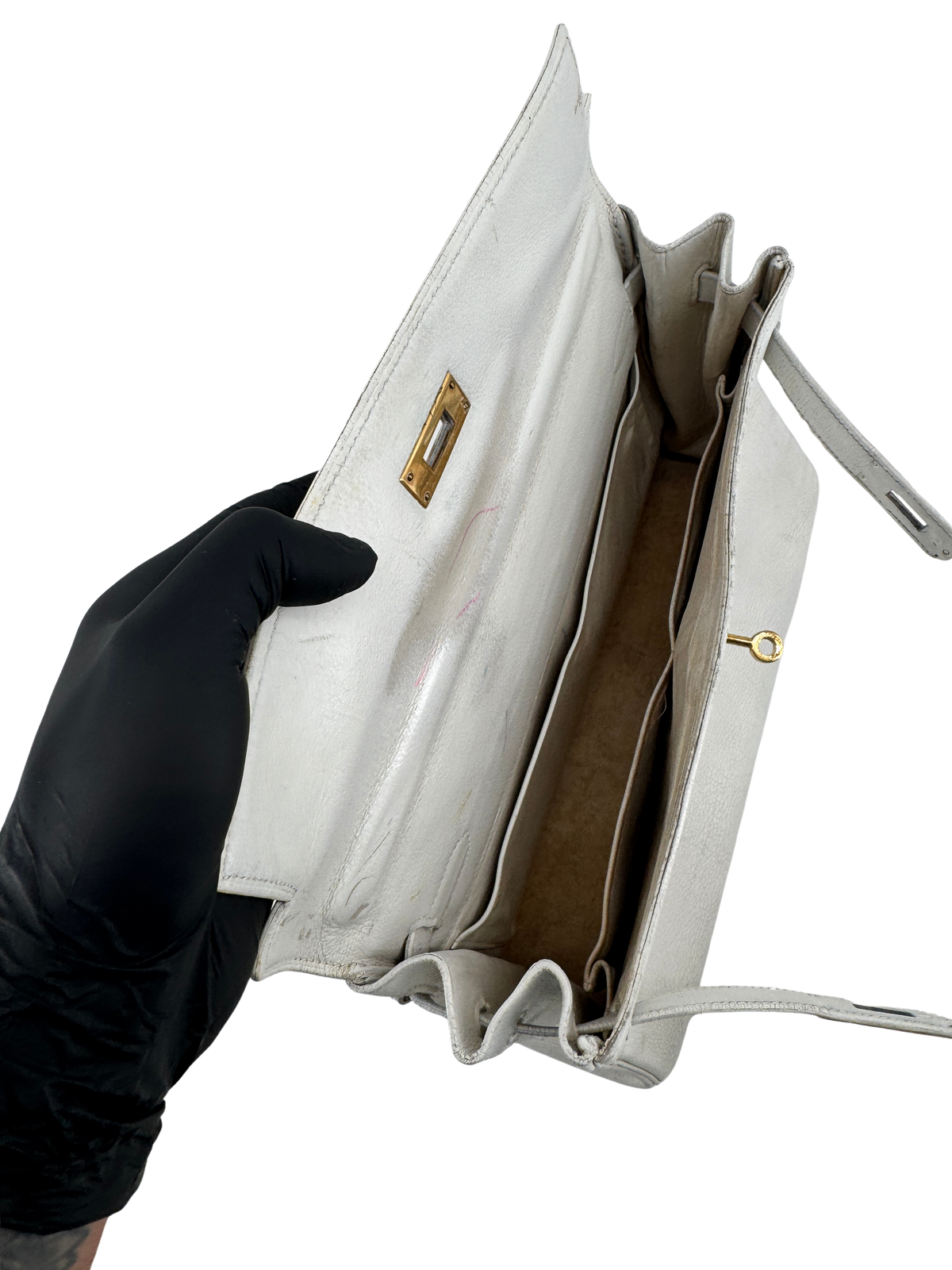
Looking closely at this 1965 example in black Box leather makes its logic clear. Nothing about it seems truly superfluous. The gussets give the bag its volume; the straps structure the front horizontally; the turn-lock becomes both mechanism and ornament; the handle traces a single curve above a construction dominated by geometric lines. Even the padlock, initially utilitarian, contributes to the object’s visual identity.
This ability to make what was initially functional feel precious remains at the heart of the Kelly’s vocabulary. Hermès continues, moreover, to transpose its straps, padlocks, and clasps into its contemporary jewelry creations, a sign of the graphic power these details have acquired over time.
On a vintage Kelly Retourne, the material adds another dimension. Unlike the Sellier construction, known for its sharper edges and architectural character, the Retourne construction gives the bag softer contours. Sotheby’s precisely distinguishes these two major expressions of the Kelly: the Sellier, structured with visible stitching, and the Retourne, whose edges are softer and overall appearance more supple.
Here, this suppleness has been amplified by several decades of use. The black Box calfskin is no longer a perfectly uniform surface: it reflects light differently across different areas and bears creases and signs of rubbing, while the gold-tone metal has gradually darkened and oxidized in places. The object thus acquires a depth that only an older piece can possess.
It is important not to confuse patina with perfect preservation. This Kelly displays significant and visible weaknesses, particularly around the handle, gussets, and sides. They should be considered carefully, especially with a view to regular use. But from a collector’s perspective, they also document the material life of a bag made approximately six decades ago.
This is where this Hermès Kelly 32 Retourne, circa 1965, in black Box leather finds its singularity. Not in the artificial appearance of an object that has remained untouched, but in the coexistence of two temporalities: that of a 1930s design whose proportions have become universal, and that of an individual example that has endured across the decades.
A vintage Hermès bag can thus be viewed as much as an accessory as an object of material culture. In this black Kelly, the leather, construction, and hardware still tell the story of the Maison’s craftsmanship; the marks and irregularities, meanwhile, tell the story of what cannot be manufactured: time.