



A forgotten piece of the great Hermès story
The story of the Berry bag, this discreet model in which the Faubourg Saint-Honoré house gave free rein to its mechanical genius
In the long and prestigious history of the Hermès house, founded in 1837 by Thierry Hermès, a German saddler and harness maker who settled in Paris, there is a particular category of creations: those less familiar to the general public, but which knowledgeable collectors seek out precisely for that reason. The Berry bag belongs to this discreet family, alongside the Sac à Dépêches, the 1960s Constance, the Sac Mallette, and the Glika - models produced in limited runs, overshadowed in the collective imagination by the media prominence of the Kelly and the Birkin, yet equally representative of Hermès craftsmanship.
The Berry was created in the house's Parisian workshops around the turn of the 1960s, at a time when Hermès, then led by Robert Dumas, was seeking to expand its women's collection while exploring new approaches to construction and mechanisms. The Berry immediately stood out for a feature that made it unique within the house's repertoire: its patented clasp with an articulated tab mounted on a rigid frame. Whereas the Kelly relies on a system of crossed straps inherited from saddlery, and the Constance closes with a rotating "H" plate, the Berry introduced an entirely new type of mechanism: a horizontal metal bar integrated into the bag's structure, over which folds a leather tab pivoting on a rigid golden frame. This system, combining watchmaking precision with remarkable ease of use, perfectly illustrates Hermès' obsession with uniting formal beauty and mechanical functionality.
Produced mainly between the 1960s and the 1990s, the Berry bag came in a variety of sizes (generally 30 and 32 cm) and leathers, including Box Calf, Veau Chamonix, and Courchevel, and sometimes even exotic leathers. Yet throughout its history it remained a discreet creation, never produced in large quantities and never promoted with the fanfare surrounding the house's major iconic models. This deliberate discretion explains its relative rarity on the secondary market today: while hundreds of Kelly and Birkin bags are offered for resale each season, authentic Berrys appear only sporadically, primarily at specialized auctions in Paris, Beaune, or Strasbourg. Each rediscovered example is therefore a small celebration for collectors - an opportunity to hold in their hands a lesser-known, but by no means less precious, piece of the great Hermès story of the 20th century.
Our piece, made around 1970, belongs to the model's most mature period - the time when the workshops' craftsmanship had fully incorporated the subtleties of the patented mechanism, and when Chamonix calfskin in its historic Gold color was one of the most sought-after combinations in the Hermès catalog. Appraised by Jérôme Lalande, one of the most highly regarded luxury leather-goods experts in the Parisian market, and offered by the Alexandre Landre house, this piece is a particularly well-preserved example of this discreet model - a rare opportunity to own an authentic fragment of Hermès heritage from the Trente Glorieuses.

Creative vision and exceptional craftsmanship
The art of Chamonix calfskin and the color Gold according to Hermès, when the material alone tells the story of a maison
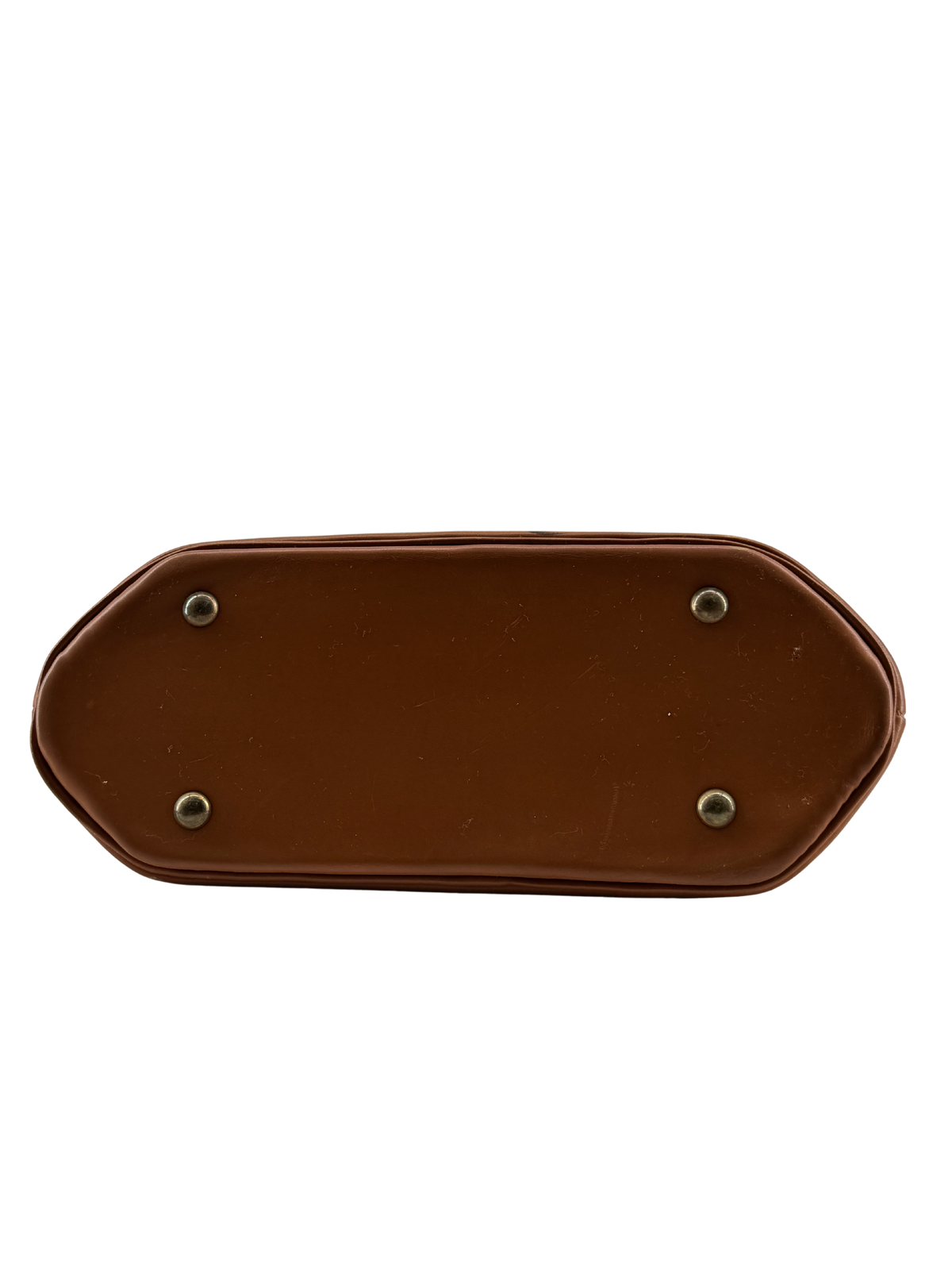
The entire singularity of this vintage Berry lies in the meeting of three elements deeply linked to the DNA of the Hermès house: material, color, and mechanism. First, Chamonix calfskin, that historic leather whose name pays tribute to the French Alpine town, is one of the house's most subtly characteristic materials of the 1960s and 1970s. Halfway between the satin sheen of Box Calf and the more lively grain of Togo, Chamonix offers a smooth, matte, dense, and soft-to-the-touch surface, one of whose great qualities is its ability to develop a soft, warm patina over time, without ever giving in to cracking or pronounced signs of wear. It is a leather that ages gracefully, gains depth over the years, and perfectly embodies the Hermès idea of enduring luxury.
The “Gold” color, this honeyed caramel fawn shade, deserves a chapter in the history of the house all by itself. Born in the immediate postwar period, at a time when the scarcity of industrial dyes forced tanners to work primarily with leather in its natural shade, it gradually became one of the most emblematic colors in the Hermès catalog, to the point that it is now considered the house's ultimate signature color - the one that, alongside the famous orange of its boxes, encapsulates the entire Hermès imagination. This particular shade, at once sunny, warm, and profoundly timeless, pairs admirably with every silhouette, every season, and every style - it is the ultimate all-purpose staple of a luxury wardrobe, and one of the most sought-after choices in authentic vintage.
Finally, mechanically, the patented rigid-frame closure represents a special moment in the history of Hermès creations. It bears witness to an era when the house, drawing on more than a century of saddlery heritage, sought to invent new technical solutions worthy of its standard of perfection. The gold-plated horizontal bar, the saddle-stitched leather swivel tab, and the articulated metal frame that structures the entire upper part of the bag: each component was designed, prototyped, and perfected in the Faubourg workshops before being produced in small series. The opening gesture, as simple as a turn of the wrist, reveals the full tactile satisfaction provided only by mechanisms created by the great French leather-goods houses - that almost watchmaking precision that distinguishes true luxury pieces from objects that merely claim to be.
Symbolically, this circa 1970 Chamonix Gold calfskin Berry occupies a singular place in the imagination of French heritage luxury. It represents more than fifty years of French history contained within an architectural silhouette - the Trente Glorieuses, Hermès's nascent globalization, the golden age of discreet leather goods, and an era when every bag was made to order for a discerning clientele. Owning it today means more than simply carrying a bag: it means entering the select circle of enthusiasts who know that true rarity does not always lie in the most publicized models, but often in these discreet pieces that the house has left behind as fragments of creative experimentation. An object for connoisseurs, expertly appraised and authenticated, intended for those who prefer a culture of detail to the obviousness of icons.